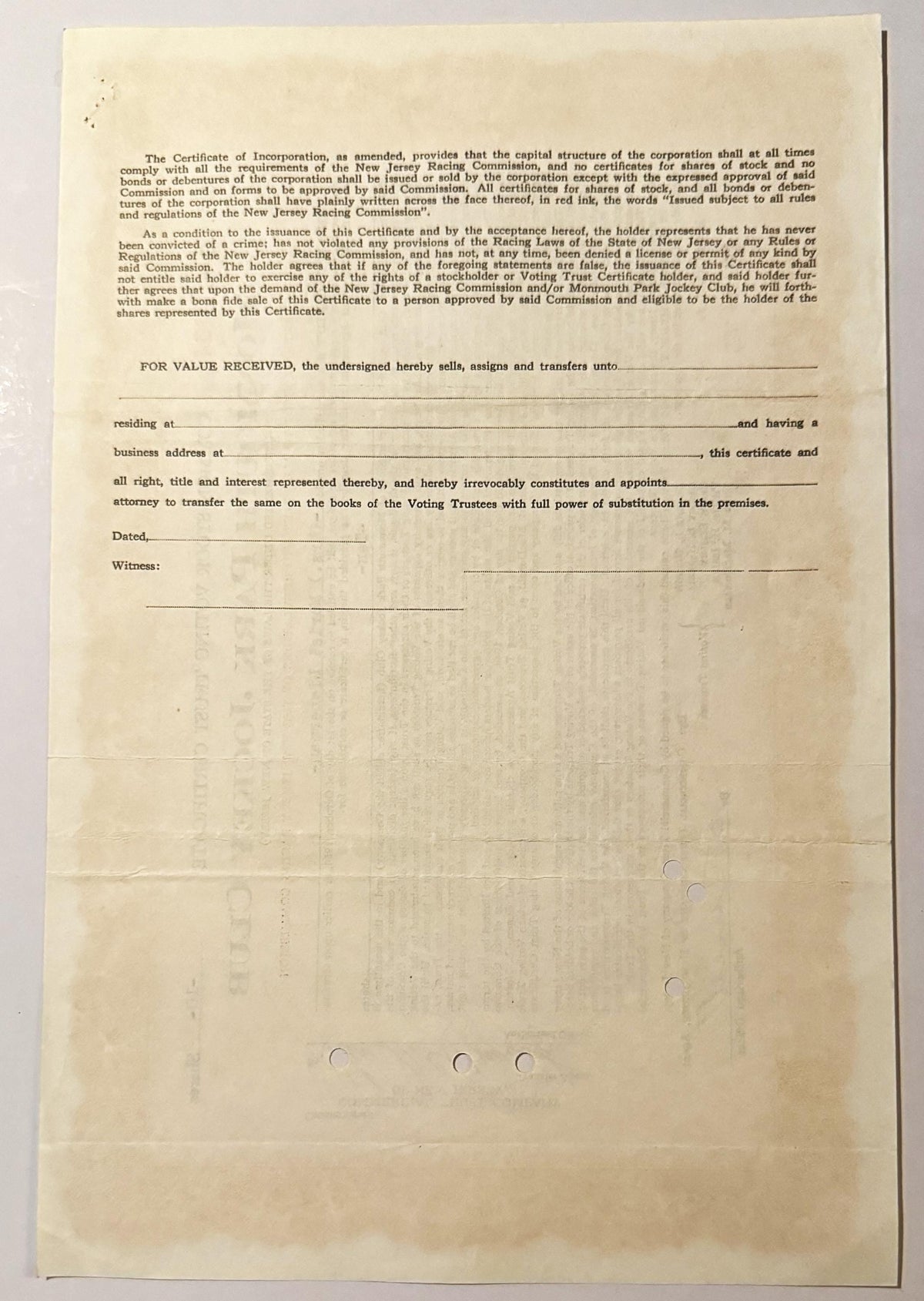
Vintage 1940s–1950s Monmouth Park Jockey Club Stock Certificate 🏇 Postwar Jersey Shore Horse Racing
Vintage 1940s–1950s Monmouth Park Jockey Club Stock Certificate 🏇 Postwar Jersey Shore Horse Racing
🏇 What does it look like when a whole racetrack decides to come back to life?
Hold this piece of paper up to the light and you are holding a little of that answer. This is a genuine Common Stock Voting Trust Certificate of the Monmouth Park Jockey Club, printed in the warm, unmistakable orange engraved border that scripophily people know at a glance. It comes out of the years when the “new” Monmouth Park at Oceanport, New Jersey was young, hopeful, and rebuilding an entire sport from the ground up along the Jersey Shore. It is at once a financial document, a piece of Thoroughbred-racing history, and a small work of the engraver’s art — and every time we look at one, we are reminded why we started collecting these in the first place.
At Vintage and Antique Gifts we treat certificates like this the way a local historical society treats a founding record: as something worth keeping, worth explaining, and worth passing on with its whole story intact. So settle in. This one has a good story.
📜 What this certificate actually is
This is a Common Stock Voting Trust Certificate of the Monmouth Park Jockey Club, incorporated under the laws of the State of New Jersey and issued subject to the rules and regulations of the New Jersey Racing Commission — a line printed right across the face in red. It dates to the 1940s and early 1950s, the first great chapter of modern Monmouth Park. Each certificate measures approximately 12 x 8 inches, a generous, frameable sheet with plenty of presence on a wall.
The certificates in this class were issued under a Voting Trust Agreement dated October 1, 1944, and were countersigned by the Commercial Trust Company of New Jersey, acting as agent for the voting trustees. The voting trustees printed on the certificate are a genuine who’s-who of postwar New Jersey racing: Eugene L. Norton, Amory L. Haskell, Reeve Schley, Philip H. Iselin, and John M. MacDonald. Those names are not decoration — two of them are quite literally stamped onto the modern racing calendar, and we will get to why in a moment.
Because we keep more than one of these, the certificate you receive is a genuine period example of the type, and each real-world sheet carries its own hand-entered and hand-stamped details from the day it was in use — which is part of the charm of original scripophily: no two are ever quite identical. What is constant, and what makes these worth owning, is everything you see engraved on the face: the issuer, the orange border, the trustee names, the New Jersey Racing Commission language, and the deep-etched craftsmanship of a real security printing house.
As a working financial document, a piece like this can carry its own record of handling: things like endorsement signatures, transfer-agent stamps, revenue stamps, cancellation punches, staple holes, or pencil ledger notes. Read that way, marks like these are not a knock against the piece — they are part of its story.
🌊 June 1946: a sport comes back to the Jersey Shore
To understand why anyone printed stock in a racetrack, you have to understand what New Jersey had just done. For more than half a century, legal Thoroughbred racing had gone dark in the Garden State. When the gates of the rebuilt Monmouth Park swung open at Oceanport on June 19, 1946, they ended a statewide drought of roughly fifty-three years without major racing. Nearly nineteen thousand fans poured in on that first afternoon, and for New Jersey racing people it felt less like an opening day and more like a second founding.
That rebirth had to be paid for. Grandstands, barns, a fresh racing surface, stables, paddocks, the whole apparatus of a first-class Thoroughbred plant — all of it was financed the old-fashioned way, by issuing corporate stock to the people who believed in the idea. Certificates like this one are the paper record of that belief. They are, in the most literal sense, shares in the dream of bringing the horses back to the shore. When you frame one, you are framing the moment a whole region bet on itself and won.
🏛️ The older Monmouth: a name with real roots
The Monmouth Park name did not appear out of nowhere in 1946. The original Monmouth Park first opened its gates back in 1870, in the golden post-Civil-War age of American Thoroughbred racing, when seaside race meetings were part of the summer social season and the sport drew enormous crowds. That first era of Monmouth eventually went dark along with the rest of New Jersey racing amid the anti-gambling politics of the 1890s, but the name never lost its shine. When racing returned in the 1940s, the founders reached back and revived that historic identity on purpose — they were not starting a new track so much as resurrecting a legendary one. A certificate from the postwar company is therefore a link in a chain that runs all the way back to the 1870s, carrying more than seventy years of Jersey Shore racing lore on a single engraved sheet.
🏆 The men on the certificate — and the races named after them
Here is where the printed names turn from fine print into headlines. Among the voting trustees engraved on this certificate is Amory L. Haskell, the driving force behind modern Monmouth Park and one of the great builders of twentieth-century American racing. His name did not fade into an archive — it became one of the most famous races in the sport. The Haskell, run every summer at Monmouth Park, has grown into one of the premier events for three-year-olds in the country, regularly drawing Kentucky Derby winners and Triple Crown contenders to the Jersey Shore. When you tell a racing fan that Amory Haskell’s name is printed on your certificate, you are connecting your piece of paper directly to a race they watch on television every July.
He is not alone. Philip H. Iselin, another trustee named on the face, went on to become a central figure in the track’s leadership, and Monmouth honored him too with a stakes race carrying his name on the fall calendar. Reeve Schley, Eugene L. Norton, and John M. MacDonald round out a slate of businessmen and sportsmen who put their reputations behind the revival. This is what makes the document special beyond its good looks: it is signed, in effect, by the founders of an institution that is still running world-class races today. The people who built the modern Jersey Shore racing scene are right there on the page.
🖋️ What a “voting trust certificate” is — and why collectors love them
Most people have never seen the words “voting trust certificate” before, and that unfamiliarity is exactly what makes them fun to own and explain. A voting trust is a legal arrangement in which shareholders hand their voting rights to a small group of voting trustees for a set period of time, receiving in return a certificate like this one. The idea is to keep a young company’s direction stable and unified while it finds its feet — a very sensible thing to do when you are rebuilding an entire racetrack and want everyone rowing in the same direction. The certificate spells out that the holder is entitled to receive ordinary stock at the end of the trust period, and it lays out the trustees’ powers in dense, wonderful, period legal prose.
For collectors, that arrangement is a gift. It means the certificate names actual, identifiable people — the trustees — rather than a faceless corporation, and in this case those people are historically significant. It also ties the paper to a specific, dramatic moment: a brand-new company consolidating control so it could pull off something ambitious. Scripophily — the hobby of collecting antique stocks and bonds — prizes exactly this kind of document: beautiful, historically grounded, and full of stories the moment you start reading the fine print.
🖨️ Engraved by a real bank note house
Look closely at the border and lettering and you can see this was not run off on an office press. The face carries the imprint of the Hamilton Bank Note Company of New York, one of the security-printing houses that engraved stocks, bonds, and financial paper the same painstaking way currency was made. The orange engraved border, the fine geometric lathe-work, the crisp serif headline reading MONMOUTH PARK JOCKEY CLUB — all of it is steel-plate engraving, designed to be difficult to forge and, as a happy side effect, genuinely beautiful. That is why a framed certificate reads as art from across a room and rewards close inspection up close. The craft is a huge part of the appeal: this is the same discipline that produced the era’s banknotes, turned toward a racetrack on the Jersey Shore.
🖼️ Display ideas
- 🏇 Frame it as the centerpiece of a horse-racing or Thoroughbred wall — it pairs beautifully with racing prints, win photos, and old program covers.
- 🧡 Let the warm orange border set your palette in a study, library, or home bar, matted in cream and set in a simple dark or gilt frame.
- 🏢 Hang it in an office or boardroom as a conversation piece — a real corporate document with a genuinely great backstory beats generic wall decor every time.
- 🌊 Build a Jersey Shore or New Jersey history corner around it, alongside shore-town maps, postcards, and local memorabilia.
- 🎓 Group two or three period certificates together for a gallery-style scripophily arrangement, where the engraving details play off one another.
- 🎁 Stand it on a shelf easel in a den or man-cave where the light can catch the engraving through the day.
🎁 Who collects these
This piece sits happily at the crossroads of several passionate crowds. Scripophily collectors hunt down engraved stocks and bonds precisely like this one. Horse-racing and Thoroughbred fans love the direct tie to Monmouth Park and the Haskell. New Jersey and Jersey Shore history buffs treasure anything from the 1946 rebirth. And it makes a wonderful, unexpected gift for the racing enthusiast, the finance or Wall Street professional who appreciates a handsome antique certificate, the office that wants a piece with a story, or the person who already has everything and would never think to buy themselves a beautifully engraved slice of American sporting history.
❓ Frequently asked questions
Is this an original certificate or a reproduction?
It is a genuine, original period certificate from the Monmouth Park Jockey Club, engraved by a real bank note company — not a modern reprint or a photocopy. You are getting authentic mid-twentieth-century scripophily.
What is a “voting trust certificate” exactly?
It is a certificate given to shareholders who placed their voting rights with a group of trustees for a set term. It represents their interest in the company’s common stock and their right to receive ordinary shares when the trust period ended. In practice it is a stock certificate with an extra layer of history baked in.
Who are the names printed on it?
The engraved trustees include Eugene L. Norton, Amory L. Haskell, Reeve Schley, Philip H. Iselin, and John M. MacDonald — leading figures behind the postwar rebirth of Monmouth Park. Haskell and Iselin each have a major stakes race at the track named in their honor.
How big is it, and will it frame easily?
Each certificate measures approximately 12 x 8 inches, which fits standard and readily available frame and mat sizes. It makes a striking framed piece with almost no fuss.
Why does it say “New Jersey Racing Commission” on it?
Because Thoroughbred racing in New Jersey operated under state regulation, the certificate was issued subject to the rules and regulations of the New Jersey Racing Commission — a requirement printed right on the face, and a lovely piece of the document’s authenticity.
Will the one I receive look exactly like the photos?
It will be the same class of certificate, with the same engraving, border, issuer, and trustee names shown. As with all original vintage scripophily, the individual hand-entered details vary from sheet to sheet, so your example will be its own one-of-a-kind survivor of the era.
Why does a document like this matter today?
Because it is a tangible piece of the moment a sport and a shoreline reinvented themselves. It ties together New Jersey history, the origins of the Haskell, the golden age of engraved financial paper, and the simple, human story of people betting on a comeback — all on one frameable sheet.
🔎 More From The Vintage & Antique Gifts Archive
- Vintage 1960s Monmouth Park Jockey Club Stock Certificate 🏇 Oceanport NJ Horse Racing History
- Vintage San Juan Racing Association Stock Certificate 🐎 El Comandante Puerto Rico Racetrack
- Vintage San Juan Racing Association 🏇 1960s Stock Certificate — El Comandante Racetrack Puerto Rico Scripophily Bache duPont American Made
Couldn't load pickup availability
Low stock: 9 left
View full details