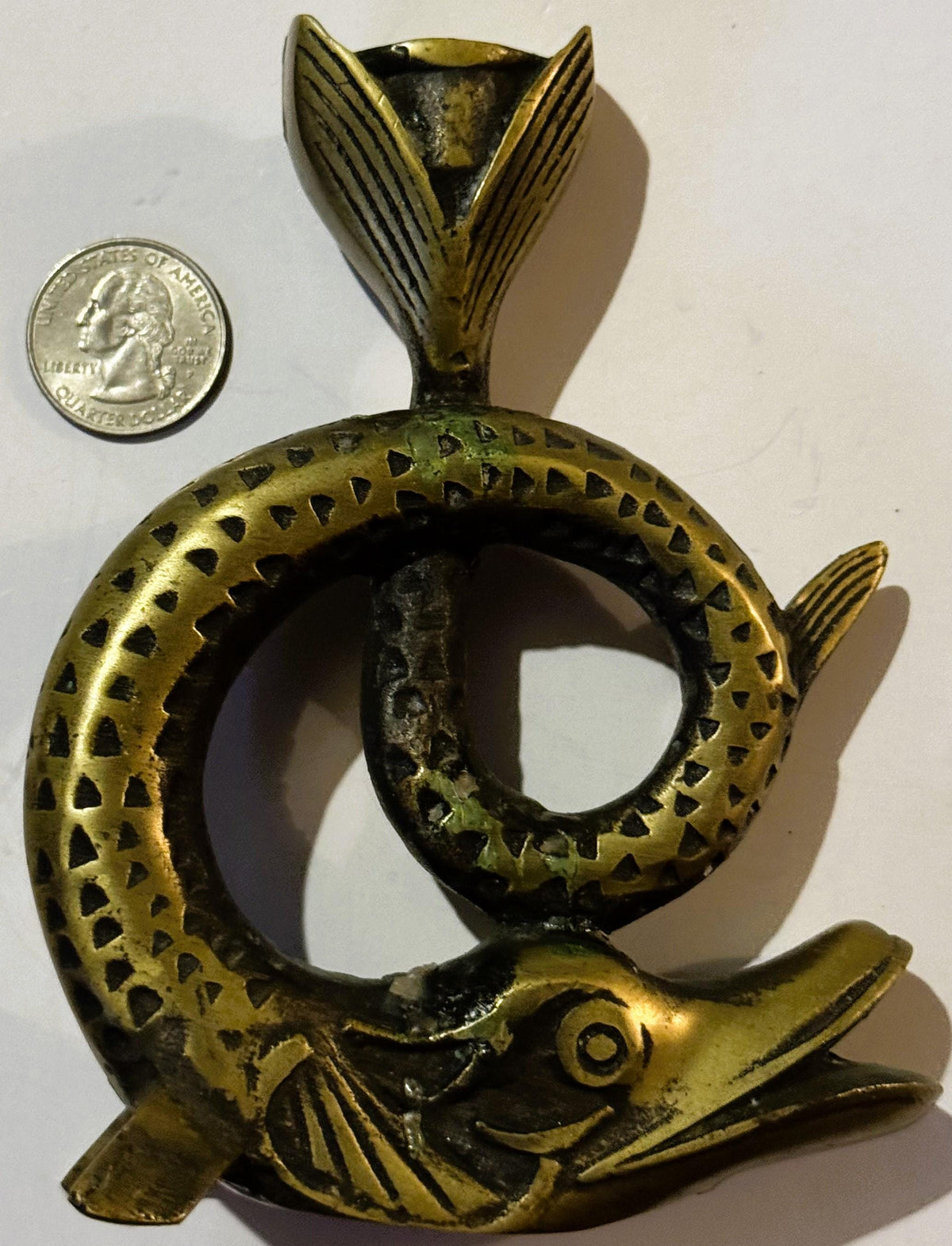
Vintage Bronze Fish Candlestick 🐟 Coiled Figural Candle Holder with Aged Verdigris Patina
Vintage Bronze Fish Candlestick 🐟 Coiled Figural Candle Holder with Aged Verdigris Patina
🐟 What Kind of Fish Holds a Candle?
Every so often an object comes along that refuses to be just one thing, and this is one of them. At first glance it reads as a small sculpture — a fish, caught mid-leap, its body curled into a tight open coil and its head thrown forward with the jaw wide. Look a moment longer and the second life of the thing reveals itself: the fish's tail rises at the top and opens into a shallow cup, and that cup is a candle socket. This is a bronze fish candlestick, a figural candle holder in the shape of a long-bodied, open-jawed fish, and it belongs to that small, satisfying family of objects that do a real job while doubling as something you simply want to look at.
Everything on this page comes straight from the object itself and the photographs of it. There is no maker's name on it, no stamped date, no country cast into the metal — and so you will find none of those invented here. What there is instead is the piece: its form, its surface, the way age has coloured it, and one genuine little mystery on its underside that we will get to honestly rather than pretend to solve. Build your impression from the photos and the notes below, because between them they tell you everything there is to know about it.
🔍 What You Are Actually Looking At
The subject is a fish rendered with real character. Its head sits low at the front, with a long, open jaw, a raised eye ringed like a small target, and neat incised lines sweeping back across the gill cover — the streamlined, predatory look that gives it the air of a pike. Just behind the head a pectoral fin fans out, its rays picked out in fine engraved strokes, and the same careful hand shows up all along the body: the entire back is worked in row upon row of small chased triangles, a stylised run of scales and dorsal spikes that catches the light differently at every angle.
From there the body does something a living fish never could — it sweeps up and around into a tight, open coil, a loose curl with daylight showing clean through its centre, before carrying on up to the tail. It is part fish, part flourish, and that openwork loop is a big part of why the piece is so much fun to look at: it throws shadows, it frames whatever sits behind it, and it keeps the eye travelling. A US quarter appears alongside it in several of the photographs, so you can judge its true size directly from the images rather than from any description.
🕯️ A Candle Holder Hidden Inside a Fish
Here is the clever part. The fish's tail flares up at the top and curls forward into a cup, and set into that cup is a round socket sized to take a standard taper candle. The whole design is built around that single idea: turn the animal's own body into the mechanism, so the candle appears to rise straight out of the leaping fish rather than out of any obvious holder. It is exactly the kind of solution a maker reaches for when they want a functional object to also read as a small sculpture — and it works, lit or unlit.
And it genuinely functions. It stands squarely on its own and holds a candle, resting on the flat underside of its body with the head forward and the tail-cup up, steady and level. This is a real candle holder that happens to be shaped like a jumping fish — not a fragile ornament that only pretends to be one. Seat a taper in the tail and light it, and the flame sits right where the design always meant it to.
🎨 The Curve Is the Design
It is worth saying plainly, because a still photograph can raise the question: the dramatic bend of the fish is intentional — it is the whole point of the design, not something that happened to it. The arc of the body, the coil, the upthrown tail: all of it is the sculptor's line, the sense of a fish frozen at the top of its leap. The piece is a single, solid object, worked as one, and it sits and works exactly as it was meant to. What looks like motion is design doing its job.
That solidity is a real part of the pleasure of a metal piece like this. There is genuine heft to it, a density you feel the moment you pick it up, and every line — the jaw, the eye-ring, the gill strokes, the fin rays, the endless little scale-triangles running the length of the back — was cut into that solid body to be run over with a thumb as much as seen. It is a small object with the presence of a much larger one.
🌿 Gold, Shadow, and Green
The surface is where age has signed its name. On the high points — the crown of the head, the ridges of the coil, the raised edges of the tail — the metal still reads as warm, bright gold, burnished by handling and by light. Sink into the recesses and the tone deepens to a dark brown-bronze, and in the deepest crevices the metal has turned green: verdigris, the soft blue-green bloom that only genuine old copper alloys grow, gathered here along the coils, around the rim of the candle cup, and in the shadows of the chased scales.
This is not something to apologise for — it is the best thing about the piece. A deep patina and real verdigris are exactly what collectors of antique and vintage metal look for, because they cannot be convincingly faked and they cannot be rushed. A brand-new casting is a single flat, dead colour; this one carries a whole map of gold, brown, and green drawn across it by time, and no two square inches of it are quite alike. It is the visible proof that the object is a genuine survivor of its own years, and on a piece like this it is treasured, not tolerated.
🐠 The Fish, a Favourite of Makers Everywhere
The fish is one of the oldest decorative subjects there is. Long before this particular object existed, makers in cultures all over the world were shaping fish out of metal, clay, and wood — for the sheer graphic pleasure of that streamlined body and sweeping tail, and for the meanings the fish has carried nearly everywhere it swims. Across many traditions the fish stands for water and abundance, for luck and plenty, for the angler's patience and the fisherman's prize. None of that is a claim about where this piece was made or why; it is simply the long, broad current that any fish-shaped object floats in, and part of why a fish rendered this confidently still speaks so easily to so many people.
A figural candle holder like this one sits inside its own small tradition, too — the habit of making an everyday, functional thing into a little sculpture, so the object earns its place on the table twice over: once for what it does, and once for what it is. That is exactly the trick this fish pulls off.
🔮 The Little Mystery on the Underside
Now the honest part, and the most interesting. On the flat underside of the fish's belly, just below the head, there is a clean rectangular opening cut into the metal — a neat, deliberate slot, clearly visible in several of the photographs. It was plainly made on purpose. What we will not do is pretend to know exactly why.
Its original function is genuinely unknown. It is easy to imagine a fitting slot like this once helped seat the fish onto a base, join it to a fixture, or mate it with some companion piece long since parted from it — but that is imagination, not documentation, and we would rather hand you the honest question than a confident guess. Treat it as a point of interest rather than a flaw: a small, deliberate detail that hints the object may once have been part of something a little larger, and that quietly invites its next owner to wonder. If you know these forms well and can place it, we would genuinely love to hear what it is.
🖼️ Ways to Live With It
The fish slips easily into a modern room, and it does not have to hold a flame to earn its keep.
- 🕯️ Give it its real job: seat a taper in the tail-cup and let the candlelight play off the gold high points and the green-touched recesses — the deep relief throws wonderful little shadows.
- 📚 Stand it on a shelf, mantel, or stack of books purely as a sculpture, where the open coil frames the space behind it and the whole silhouette does the work.
- 🌊 Lean into the water theme in a lake house, cabin, coastal room, or angler's den, grouped with other fish, brass, or nautical pieces.
- 🖥️ Set it on a desk or an entry table as a conversation piece with genuine weight and presence — the kind of small object a visitor picks up without asking.
- 🎣 Pair it with a vintage lure, an old reel, or a stack of field guides to build a little fishing-desk vignette it anchors instantly.
🎁 Who It Belongs With
This one will land hardest with a few particular people. There is the collector of figural and novelty candle holders, who knows how much better the good ones look when the function is built right into the form. There is the fish- and angling-decor lover — the person whose shelves and walls already lean toward water, lures, and leaping trout and pike — for whom a solid metal fish is an easy yes. There is the collector of aged brass and bronze, who will read the verdigris and the deep patina at a glance and simply want a good, honest, characterful example to own. And there is the gift-hunter after something with real weight and a real story in it — for an angler, a candle lover, or anyone drawn to small sculptures that also do a job. For any of them, this is a single, individual object: there is only the one.
❓ Questions Worth Answering
Is it marked, signed, or dated?
No. There is no maker's mark, foundry stamp, signature, country, or date anywhere on the piece — we looked closely. That is precisely why you will find no origin or age claimed here: we describe only what the object and the photographs actually show.
Does it really stand and hold a candle?
Yes. It rests squarely on the flat underside of its body, and the tail-cup takes a standard taper candle. It is a working candle holder as much as it is a sculpture.
Is the fish meant to be curved like that?
Yes — the bold curl and the upthrown tail are the intended design, the look of a fish caught mid-leap. The piece is a single solid object and sits and works exactly as it was made to.
What is the rectangular opening on the bottom?
It is a clean, deliberate slot cut into the flat underside of the belly, just below the head. Its original purpose is genuinely unknown — quite possibly a fitting or mounting provision — and we say so openly rather than invent an answer. It is shown clearly in the photographs.
What is that green colour?
Verdigris — the natural blue-green patina that genuine old copper alloys such as brass and bronze develop over time. It gathers in the recesses and around the candle cup, and it is a desirable sign of real age, not damage.
How big is it?
It is a compact piece. A US quarter is included in several photographs so you can gauge its true size directly from the images.
How many are available?
One. This is a single, individual object, offered exactly as pictured.
✨ Why It Matters
Some objects are worth having because they are rare; this one is worth having because it is real, useful, and full of character. It is a fish caught mid-leap in solid metal, with a candle cup worked cleverly into its own tail, coloured now by the honest gold, brown, and green of years actually lived, and carrying one small, deliberate mystery on its underside that even we cannot fully explain. It claims no invented pedigree, and it needs none. What it offers is the thing itself — a functional little sculpture with weight in the hand and a story you can read straight off its surface. Bring it home, set a candle in the tail, and let it do exactly what it was so clearly made to do: hold a light, and hold your attention.
🔎 More From The Vintage & Antique Gifts Archive
- Antique Eastlake Steeple Tip Door Hinge 🚪 — Victorian 5x5 Cast Bronze Aesthetic Movement Architectural Salvage
- Antique Chinese Bronze Censer 🐉 — Lidded Incense Burner, Peach & Leaf Lid, Chilong Dragon, Late Qing
- Antique Chinese Republic Period Bronze Crab Figurine 🦀 in Bamboo-Form Cage Scholar's Object
Couldn't load pickup availability
Low stock: 1 left
View full details